-
Monday - Friday, 8:00am- 5:00 pm
- +86-13306182632
- meixiaobo@ylsl.net
Monday - Friday, 8:00am- 5:00 pm
Thermal insulation
Reduce heat loss: Hemp felt has certain thermal insulation properties. In cold seasons, it can effectively block the heat in the chicken house from radiating outward, keep the chicken house warm, reduce the energy consumed by the chickens due to the cold, and help improve the growth rate and egg production rate of chickens.
Block external heat: In hot summer, hemp felt can block the high temperature from the outside from entering the chicken house, prevent the temperature in the chicken house from being too high, keep the chickens in a more comfortable environment, reduce heat stress, and reduce the risk of heat stroke in chickens.
Moisture-proof and moisture-absorbent
Absorb moisture: Hemp felt has strong hygroscopicity and can absorb excess moisture in the air in the chicken house, maintain a relatively dry environment in the chicken house, and prevent various problems caused by moisture, such as mold growth and respiratory diseases in chickens.
Regulate humidity: When the humidity in the chicken house is too high, hemp felt absorbs moisture; when it is dry, hemp felt can release a certain amount of moisture, which plays a role in regulating the humidity of the chicken house, so that the humidity in the chicken house is kept within a relatively stable range.
Sound insulation and noise reduction
Reduce external noise interference: Hemp felt has good sound insulation performance, which can effectively block external noise from entering the chicken house, create a quiet living environment for the chickens, reduce the stress response of the chickens due to external noise, and is conducive to the growth and egg laying of the chickens.
Reduce the noise in the chicken house: The activities and calls of the chickens in the chicken house will also produce a certain amount of noise. Hemp felt can absorb and reflect some of the noise, reduce the noise level in the chicken house, and make the environment in the chicken house quieter and more comfortable.
As litter
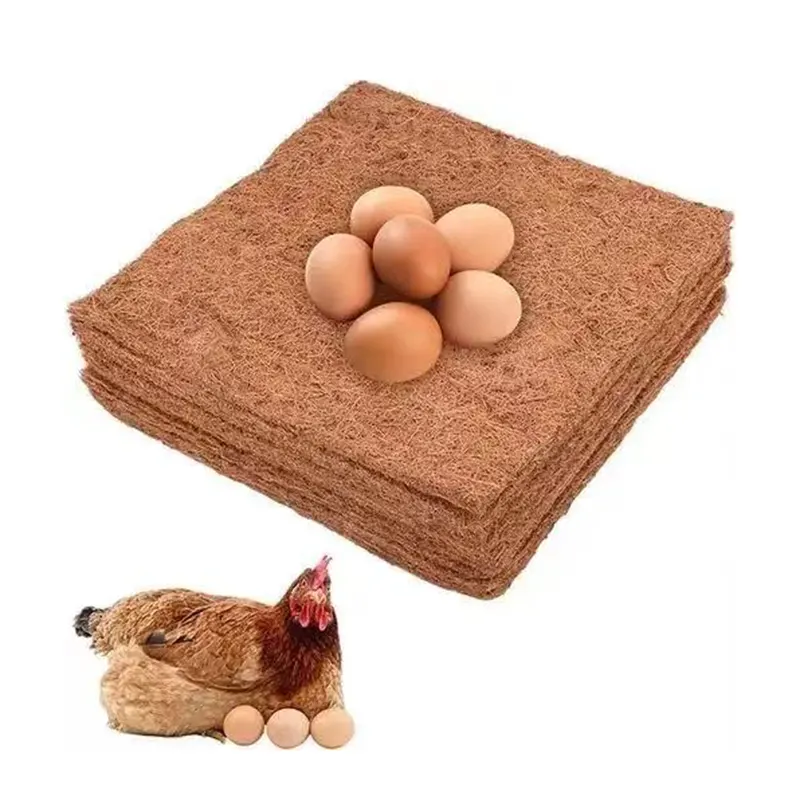
Provide a comfortable resting place: Spreading hemp felt on the floor of the chicken house or in the chicken cage can provide a soft and comfortable resting place for the chickens, reduce the direct contact between the chickens and the cold ground or hard cages, and reduce the incidence of leg diseases in the chickens.
Easy to clean: Hemp felt is relatively easy to clean. Regular replacement of hemp felt can keep the chicken house clean and hygienic, reduce the accumulation of feces and debris in the chicken house, and reduce the risk of bacteria and viruses.
Our company can provide natural plant jute fiber chicken house mats with leading foreign technology. They are naturally biodegradable, heat-insulating, moisture-proof, sound-proof, antibacterial and insect-inhibiting, soft and comfortable. Provide a healthy and comfortable growth environment for hens and chicks.
Pain points of agricultural chicken house mats
I. Environmental control issues
Humidity control failure
Insufficient moisture absorption capacity of the litter leads to moisture accumulation. Rice husks and other materials have poor moisture absorption and are prone to local water accumulation, causing bacterial growth and excessive ammonia concentration (reference case: a chicken farm caused a 17% increase in the outbreak rate of coccidiosis due to damp litter) 34
Improper water source control (water dispenser leakage, excessive use of cooling water curtains) further aggravates the dampness of the litter 47
Excessive harmful gases
Wet litter accelerates the decomposition of feces, and ammonia concentration exceeds the standard for a long time. Exceeding the 20ppm safety threshold, inducing respiratory diseases in chickens37
Imbalance in temperature regulation
After the litter clumps, the thermal insulation performance decreases, and the local temperature difference during the brooding period exceeds 3℃, which directly leads to a decrease in the survival rate of chicks78
Second, hidden dangers in material selection
Biosafety risk
The sodium/calcium content of traditional litter such as wood ash exceeds the standard (the measured calcium content is as high as 15%), and long-term contact leads to abnormal bone development and reduced egg production quality in chickens2
The aflatoxin content in moldy sawdust exceeds the national limit standard (>50μg/kg)8
Physical performance defects
Material type Main problem Data reference
Rice husk Moisture absorption rate <30%, easy to cause coccidia infection 48
Wood shavings Dust concentration >5mg/m³, induces asthma in chickens 8
Straw Carbon-nitrogen ratio >50:1, slow decomposition 8
III. Pain points of maintenance and management
High labor costs
Bedding needs to be turned over daily (1.5-2 hours/1,000 square meters) to prevent compaction6
The optimal replacement cycle is 15 days, but in actual operation it is extended to 20-25 days due to cost pressure68
Difficult disinfection operation
Traditional spray disinfection causes a surge in the moisture content of the bedding by 13-18%, which in turn aggravates the reproduction of microorganisms7
Exposure treatment contradictions
Exposure and bedding are mixed to form a viscous substance, and the failure rate of mechanical manure cleaning equipment increases by 40%68
IV. Chain reaction risks
Humid environment accelerates the decay rate of vaccine effectiveness by 30%7
For every 5ppm increase in ammonia concentration, the feed conversion rate decreases by 0.8%4
Poor bedding quality directly increases the breeding cost of each bird by ¥0.5-0.88
Note: The above data are derived from industry monitoring reports and typical enterprise cases23. It is recommended to combine the Internet of Things monitoring system (such as temperature and humidity sensor networking) to achieve dynamic management1.
 Eng
Eng  简体中文
简体中文  العربيّة